
Your control tower tells you a stock-out is four days away.
The delayed shipment is visible. The affected materials are identified. You know which customers are at risk.
So far, so good.
But now comes the decision that actually determines the business outcome.
Should you transfer inventory from another warehouse? Expedite the supplier? Re-sequence production? Prioritize your most important customer and accept a shortage elsewhere?
Every option has consequences. And every option depends on assumptions about what will happen next.
What if the supplier is delayed another two days? What if demand exceeds the forecast? What if production delivers less than planned?
The real challenge is no longer knowing that something will go wrong. It is knowing which action will still make sense when reality deviates from the plan.
This is where the next generation of supply chain management begins.
We have become better at seeing problems. Not necessarily at solving them.
Over the past decades, supply chain technology has made remarkable progress.
ERP systems digitized transactions. Advanced Planning and Scheduling introduced constraint-based planning. Control towers connected data across the network, allowing companies to identify disruptions earlier and understand their impact.
These developments have created enormous value.
Yet there is a fundamental limitation, as visibility does not automatically translate into better decisions.
Different companies may detect similar same supply disruptions with similar time-to-impact, but respond very differently.
One transfers inventory immediately, only to create a shortage at the ship-from location. Another expedites supply at a cost that exceeds the margin protected. A third adjusts its production sequence and maintains service without increasing inventory.
Same visibility. Different outcomes.
The difference is decision quality.
And decision quality depends on something control towers or traditional planning systems often struggle to represent: uncertainty.
The hidden problem: supply chains don't operate according to averages
Most supply chain plans are built around expected values.
A supplier has a planned lead time of seven days. A production order is expected to deliver 10,000 units. A transportation lane has a standard transit time. A demand forecast provides the expected volume.
But what actually happens?
The supplier sometimes delivers in six days, sometimes in ten. Production yield varies. Transportation times fluctuate. Customer demand changes.
These variations are not unusual exceptions. They are part of everyday supply chain reality.
Yet many planning processes still reduce them to single values.
That creates a dangerous disconnect between the world we plan for and the world we operate in.
When uncertainty is not adequately represented, organizations compensate through additional safety stock, conservative lead times, manual buffers and expensive last-minute interventions.
The result can seem paradoxical: a supply chain can carry too much inventory overall and still be insufficiently protected against disruption.
The problem is not necessarily the amount of inventory. It is whether inventory and other resources are positioned against the risks that actually matter.
And demand variability is only part of the picture.
Uncertainty in supplier performance, production yield and transportation can be equally important. Managing the supply chain effectively means understanding how these sources of variability interact across the end-to-end network.
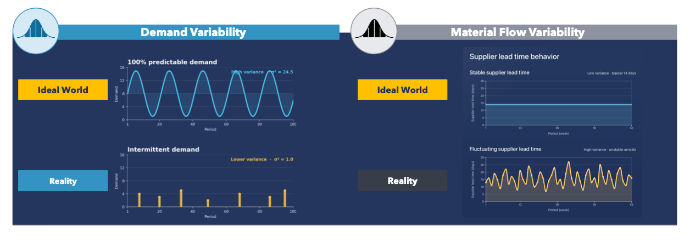
Figure 1: Demand variability and material-flow variability.
What if we could test a decision before committing to it?
Imagine returning to our original stock-out scenario.
The planning system suggests transferring 300 units from another distribution center. According to the current stock projection, the transfer resolves the shortage.
But is it really the best decision?
What happens if demand increases by 10%? What if replenishment at the sending location arrives late? What if the transfer itself takes longer than expected?
A decision that looks optimal in the base plan may perform poorly under slightly different conditions.
This is where stochastic simulation changes the conversation.
Instead of assuming that everything happens exactly as planned, a stochastic model represents uncertainty through a range of plausible outcomes.
AI and machine learning can help estimate the variability of demand, supplier lead times, production yields and transportation performance from historical data.
Monte Carlo simulation can then sample from these distributions and evaluate how different scenarios propagate through the supply chain.
The planner no longer sees just one projected future.
They can compare how different actions perform across many plausible futures. And beyond human comparison, full automation is possible, if objective function(s) are configured and introduced properly (we’ll dive into that later).
Supply chain planners can now assess, which action provides the best fulfillment to customer, respecting service level targets? Or which carries the greatest risk of creating a shortage elsewhere? Which has the least working capital impact? Which performs acceptably, even when several things go wrong?
The question changes from 'Does this action fix the problem in our plan?' to 'How robust is this action when the plan doesn't hold?'
That is a fundamentally better basis for decision-making.
Let’s look at another example on how our methodology can be of real support in supply chains: a planner can inspect the expected stock trajectory alongside optimistic and pessimistic scenarios, with the underlying inflows and outflows visible in the same view. Instead of treating a projected shortage as a single fixed outcome, the planner can see where uncertainty changes the picture.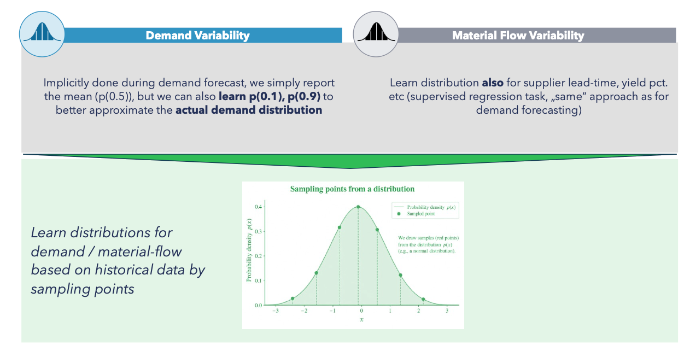
Figure 2: Monte Carlo simulation
From reacting to disruptions to continuously improving the supply chain
The opportunity becomes even more significant when simulation is combined with optimization.
Traditionally, companies use planning parameters such as safety stock, reorder points and minimum order quantities to control supply chain behavior.
These parameters are often calculated periodically, adjusted manually or maintained through relatively static rules.
But what if they could be continuously evaluated against actual network behavior?
Instead of optimizing for one expected scenario, organizations could compare alternative parameter settings across the uncertainty they experience.
The objective is not simply to find the lowest possible inventory or the highest possible service level in isolation.
It is to identify better combinations of service, working capital, operating cost and resilience.
This moves supply chain management beyond reactive exception handling.
Rather than waiting for the next disruption and deciding how to respond, the organization can proactively improve the conditions under which future disruptions occur.
That is the transition from visibility and reactive planning toward continuous decision intelligence.
AI doesn't eliminate supply chain trade-offs. It helps us make better ones.
Every supply chain operates within competing business objectives.
Sales wants high availability. Finance wants lower working capital. Operations wants efficient and stable production. Procurement wants economical sourcing. Sustainability adds another important dimension to decisions about production, inventory and transportation.
These objectives cannot all be maximized independently.
There is no algorithm that makes the trade-offs disappear.
But there is an opportunity to improve the range of achievable outcomes.
With better uncertainty estimates, simulation and optimization, companies can evaluate whether the same service level is achievable with less inventory, or whether service can improve without a proportional increase in cost and cash.
The goal is not to remove the trade-off. It is to move the performance frontier.
That is also why business priorities must remain central.
The right decision depends on what the organization is trying to achieve, which constraints it must respect and which risks it is willing to accept.
AI can strengthen the analytical foundation. It cannot independently define the company's strategy.
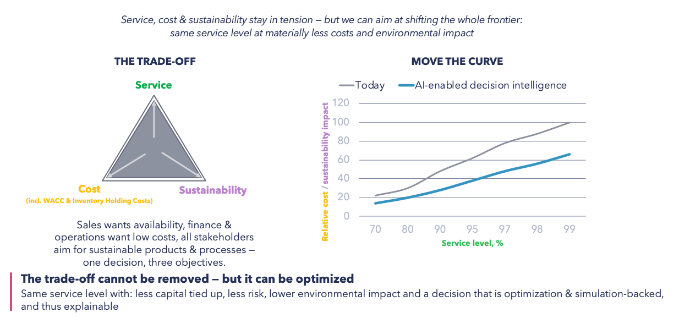
Figure 3: Cash – Cost – Service – Sustainability Trade-off
The next step: connecting what should happen with what actually happens
To make this approach operational, organizations need to connect two perspectives that are often managed separately.
The information flow describes what the organization intends to happen: demand forecasts, supply plans, production schedules and replenishment decisions.
The material flow describes what actually happens: supplier deliveries, production output, transportation performance and resulting inventory positions.
A stochastic end-to-end supply chain model integrates these perspectives.
It can represent how uncertainty propagates across the network, simulate the consequences of alternative decisions and support optimization against business objectives.
This is the foundation of what we at aioneers call Stochastic End-to-End Supply Chain Management.
It brings together established optimization methods, simulation, data models and AI-enabled uncertainty estimation into a more continuous decision-making capability.
Importantly, this does not require replacing every existing planning system.
Organizations can build on their existing planning data, execution information and stock projections.
The first step may be to improve how uncertainty is represented in a critical supply chain process. The next may be to compare mitigation actions across plausible scenarios. From there, companies can progressively optimize planning parameters and automate well-structured decisions within defined business constraints.
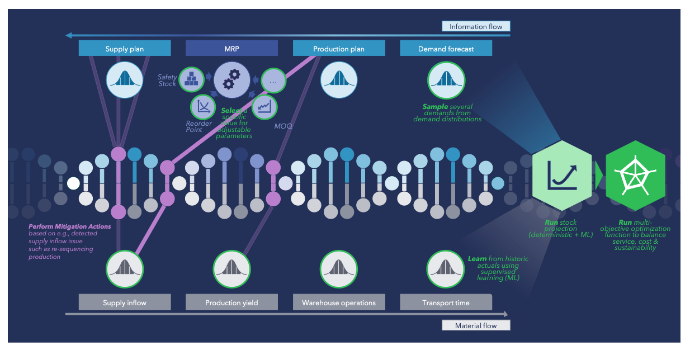
Figure 4: Stochastically integrating information & material flow for continuous simulation & optimization.
The next competitive advantage isn't seeing the future. It's preparing for multiple futures.
Supply chains will never become completely predictable.
Suppliers will be late. Demand will deviate from forecasts. Production will encounter variability. Unexpected events will continue to disrupt even the best plans.
The question is whether organizations continue to make decisions based on a single expected future, or develop the ability to evaluate what happens when reality takes a different path.
The last decade of supply chain technology was about knowing earlier.
The next will be about deciding better.
Because knowing that a stock-out is four days away is valuable.
Knowing which response remains the right one when tomorrow doesn't go according to plan is where the real competitive advantage begins.
Where is uncertainty currently costing your supply chain cash, service or operational performance?
Discover how aioneers can help turn AI-enabled simulation and optimization into a continuous supply chain decision capability.
Get in touch with our team for deeper insights and explore what’s possible for your business.
#SupplyChain #SupplyChainManagement #DecisionIntelligence #ArtificialIntelligence #SupplyChainOptimization