
Your control tower flags the problem. Your predictive model scores the risk.
And your team still spends three hours in a cross-functional call trying to agree on what caused it.
This is the gap that supply chain organizations are now confronting at scale: a growing stack of AI-powered visibility tools that are exceptionally good at showing what is happening and nearly silent on why.
It is also, we believe, the defining supply chain challenge of 2026.
In our view, the industry has named the problem
In its Top Trends in Supply Chain Technology for 2026 report, Gartner® explains,
“Decision governance applies guardrails to decision intelligence, advancing decision making with an accountability framework. This starts with a foundational-level guardrail of compliance to strategy and policy, and builds up incrementally to include impact analysis on downstream processes and contingency scenario modeling. Decision governance then moves into compliance, ethics, internal and external regulations, explainability and transparency.”
The same report calls out,
“agentic AI can address some of the current unrealistic or overly ambitious expectations of AI by being capable of closing the decision-to-execution gap.”
An AI system that can tell your inventory is 15 Days on Hand above corridor, but cannot tell you whether the driver is MOQ, lead time drift, or forecast bias, cannot close that gap. It generates a finding, not a decision.
Gartner®'s companion research on AI solution selection, Navigate Buy, Build and Hybrid Options for Supply Chain AI Use Cases (May 2026), reinforces this. It states,
“Before selecting a technology, identify if the use case requires decision support, augmentation, or automation.”
A visibility tool is not a decision tool. A prediction is not a prescription.
We think this is exactly right. And we think causal AI is the layer that bridges them.
What Is Actually Missing: The Causal Layer
Current-generation supply chain AI is built on two foundations: business intelligence (what happened) and predictive machine learning (what might happen). Both are genuinely valuable. Neither tells you which lever to pull.
The reason is structural, not a matter of data quality or model sophistication. Correlational models identify patterns. They can tell you that high MOQ and excess inventory tend to appear together. They cannot tell you whether MOQ is causing the excess, or whether both are driven by a third factor — say, a leadtime setting that has drifted from the supplier contract. That distinction is the difference between treating the symptom and fixing the problem.
This is precisely the insight behind causal AI: that supply chain performance problems are not random events, they are the downstream consequence of upstream decisions and structural parameters and those relationships can be mapped, quantified, and simulated.
An inventory causal graph, for example, maps how variables like MOQ, lead time, demand variability, safety stock settings, and order frequency connect to outcomes like Days on Hand. The graph is not a black box: every edge is derived from data, validated statistically, and tested against business logic. When an anomaly occurs — say, a component drifting to 41 DOH against a corridor of 20 — the causal system can decompose that deviation backward through the graph and attribute it to its root contributors, ranked by their actual causal weight.
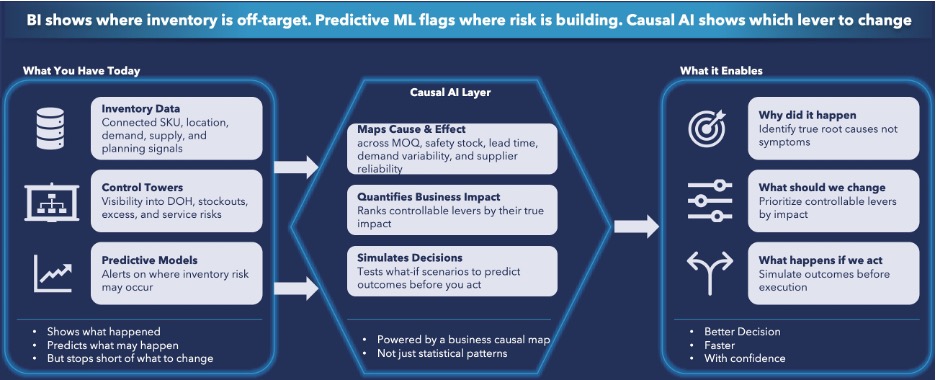
Figure 1: Causal AI – The missing layer between Insights and Actions
In a recent engagement with an automotive tier 1 supplier, that decomposition pointed clearly to supplier lead-time drift (46% contribution) and MOQ/lot-sizing (31%) as the dominant drivers, together accounting for 77% of the excess.
The counterfactual simulation then showed that renegotiating MOQ to economic order quantity would return DOH within corridor in approximately six weeks, without any risk to line supply. That is not a visibility insight. That is a decision.
The Three Capabilities That Change the Economics
The shift from correlational to causal AI in supply chain settings unlocks three capabilities that were previously unavailable:
1. True root cause attribution, not symptom flagging.
When multiple variables co-move, as they almost always do in supply chains, correlational tools cannot separate signal from noise. Causal attribution uses Shapley values distributed across a validated causal graph to assign credit for an outcome to its actual drivers. Different functions stop arguing about whose variable caused the problem, because the system has a defensible, auditable answer.
2. Counterfactual simulation before execution.
Before any change is made to safety stock settings, supplier lead times, or MOQ parameters, the causal model can simulate the expected effect on DOH, service levels, and corridor compliance, with confidence intervals. This is the “what if we force MOQ down 30%?” question answered in minutes, not in the next quarterly review.
3. Prescriptive recommendations, not open-ended findings.
The output of a causal system is not a ranked list of factors for a planner to interpret. It is a specific, quantified recommendation: change this parameter, by this amount, with this expected impact on the outcome, within this timeframe. That is what, according to us, Gartner's research means by closing the decision-to-execution gap.
The Build vs. Buy Question Has a New Answer for This Use Case
For causal AI specifically, the question is not whether to buy or build from scratch, it is whether the capability can be layered onto existing investments without disrupting them. In our experience, the answer is yes, provided the causal layer is integrated with the existing data model (ERP tables, MRP parameters, demand actuals, supply reliability metrics) rather than requiring a separate data environment.
The architecture we have developed for automotive supply chains draws directly on SAP data fields — inventory snapshots, demand signals, planning parameters, supply reliability measures — and builds the causal graph on top of them. The existing control tower remains in place. The causal AI layer adds the “why” and “what to change” without replacing the “what is happening” capabilities organizations have already built.
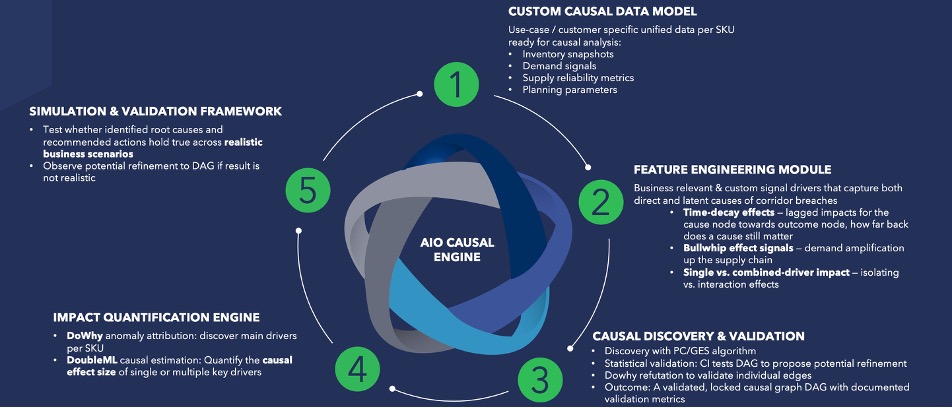
Figure 2: AIO Causal engine solution design
This matters for the economics. McKinsey research suggests that AI embedded in operations can deliver inventory reductions of 20–30%. For a major tier 1 supplier with a billion-dollar inventory base, even a conservative 10% reduction represents hundreds of millions in freed working capital and tens of millions in avoided annual carrying cost. The question is not whether the business case exists.
The question is whether the AI system can tell you which inventory to cut and which to protect, because the service and OEM-penalty risk is real.
Causal AI answers that question. Correlational AI does not.
What This Means for Supply Chain Leaders in 2026
Gartner® identifies decision governance as a top supply chain technology trend for 2026, citing the need for “explainability and transparency” in AI-driven decisions. That is not a compliance requirement. It is an operational one.
Planners do not implement recommendations they cannot explain to their managers. Procurement teams do not renegotiate supplier terms based on a model output they cannot interrogate.
The path to AI-powered decision-making at scale runs through causal transparency: systems that explain not just what the decision is, but why it is the right one, what happens if you take it, and what you are trading off if you do not.
We built our Causal AI layer to answer exactly those questions, on the data supply chain teams already have, integrated into the workflows they already use.
The missing layer between insight and action is not more data. It is causality.
Get in touch with our team for deeper insights and explore what’s possible for your business.
#CausalAI #SupplyChainAI #RootCauseAnalysis #DecisionIntelligence #SupplyChainTechnology #DecisionGovernance #AgenticAI #PredictiveAnalytics #OTIF #InventoryOptimization #WorkingCapital #OperationalExcellence
Sources
Gartner, Top Trends in Supply Chain Technology for 2026, Christian Titze, Leonard Ammerer, Chris Campbell, Kevin Lawrence, Federica Stufano, Simon Tunstall, Carlton Sapp, 19 March 2026.
Gartner, Navigate Buy, Build and Hybrid Options for Supply Chain AI Use Cases, Caleb Thomson, 20 May 2026.
GARTNER® is a registered trademark of Gartner, Inc. and/or its affiliates. Gartner does not endorse any vendor, product or service depicted in its research publications, and does not advise technology users to select only those vendors with the highest ratings or other designation. Gartner research publications consist of the opinions of Gartner's research and advisory organization and should not be construed as statements of fact. Gartner disclaims all warranties, expressed or implied, with respect to this research, including any warranties of merchantability or fitness for a particular purpose.